
Watering a neighbour's plants: a key to somebody else's home
Paula agrees to look after Mercedes's plants during her holiday. On the first visit she moves a pot and discovers that doing a favour also means knowing where it ends.
BarbellPin ·
Mercedes hands over the key in an envelope with no address on it. She's written “Paula” and drawn a watering can. They've lived on the same landing for four years, although most of their conversations have lasted no longer than a lift journey. This summer Mercedes is going away for ten days. She's asked Paula to water her plants while she's on holiday. Paula has said yes before checking how many there are.
There are fourteen, spread between the living room and an enclosed balcony. Mercedes shows her round on Sunday afternoon. Some stand on shelves; others cover a narrow table Paula had mistaken for a bench. Mercedes demonstrates what to check for each plant and leaves her instructions beside the watering can. Paula asks about the balcony key, the front door and what to do if she can't come one day.
They agree on visits, a contact and checking before making changes. Mercedes also points out two rooms Paula won't need to open. Then she looks for her suitcase, which has been blocking a drawer all afternoon. Paula goes home with the envelope. It's strange how such a small key can make the door opposite look different.

Shelf holding houseplants and a watering can. Photo: Véronique Trudel, Unsplash. Unsplash License.
The living room from the other side
On Tuesday she goes in after work. She knocks before opening, though she knows nobody is there. The living room is quiet and smells faintly of wood. From the landing she had only ever seen a lamp and the edge of a rug. Now she discovers a desk by the window and a very low chair facing the plants.
She leaves her bag by the entrance and finds the sheet. The instructions identify each pot by its position and a coloured ribbon. Paula is grateful she doesn't have to remember plant names. She follows what Mercedes showed her and notes the visit in her own diary. Afterwards she pauses to look at a plant whose leaves stretch towards the glass.
At home, she often photographs corners she has rearranged. Out of habit, she takes out her phone and frames the shelves. A document open on the desk appears in the picture too. She lowers the phone without taking it. She doesn't need a general photograph to prove she's been. If she's unsure of something, she can get close to that particular plant and ask about it.
Before leaving, she decides to move a small pot. At the end of the table it looks slightly isolated; beside the others it would look prettier. She shifts it barely a handspan. The light doesn't seem noticeably different and it isn't blocking anything. Pleased with this tiny improvement, Paula locks up and sends a message: “First visit done. All quiet.”

Potted plant on a table beside a watering can. Photo: Skye Whisler, Unsplash. Unsplash License.
There was a reason for that spot
Mercedes replies the next day. She asks about a ribbon on the small pot that should be facing the door. Paula checks the note again. She had thought the ribbon was only there for identification. She says she has moved it a little to group it with the other plants and adds a close photograph taken on her next visit.
“Could you put it back where it was?” Mercedes replies. No angry punctuation, no long explanation. Paula nevertheless feels an uncomfortable warmth in her face. She starts writing that it looked better, that she had hardly changed anything and that she only wanted to help. She reads those three reasons before sending them. None answers the question she has just received.
She puts the pot back using the reference point on the table that Mercedes gives her. She says it's done and admits she should have asked. Mercedes thanks her. Their conversation stops there. It takes Paula a while to accept that she doesn't also need a sentence absolving her of having taken a liberty.
Back in her own living room that evening, she tries moving her reading chair. From the doorway it looks better against the wall. Sitting there, she gets the lamp straight in her eyes. She puts it back. She doesn't know whether Mercedes chose that spot for the light, from habit or for some reason she hasn't mentioned. Knowing it wasn't hers is enough.

Pots and a watering can in a paved garden. Photo: Matthew Halmshaw, Unsplash. Unsplash License.
A short visit was still a favour
On Friday Paula leaves work late. She meant to visit before dinner, but traffic delays her return. She lets Mercedes know within their agreed arrangement and adjusts the visit. She doesn't try to compensate by cleaning the balcony or adding another job. She goes in, checks what they planned and closes the doors she needs to close.
In the lift a neighbour asks whether she's looking after the house too. Paula says she's taking care of the plants. The distinction comes out naturally. She has a key for a particular task. She hasn't become the flat's manager or the contact for everything that might happen in the building while Mercedes is away.
Over those days, she learns a few of the living room's sounds. The fridge starts as she fills the watering can. A passing lorry makes the blind tremble. One afternoon she thinks she hears running water, then realises rain is hitting the metal outside. She stands by the glass without opening the window and sees the street from Mercedes's usual angle.
She hasn't discovered a secret. She doesn't need to in order to feel closer. Before, Mercedes was the neighbour with cloth shopping bags and a brief greeting. Now Paula knows she leaves her slippers perfectly parallel, owns a blue watering can and trusts her to find the home just as she left it.

Flowers and plants on a wooden balcony. Photo: Hasan Almasi, Unsplash. Unsplash License.
The low chair
Mercedes returns on Sunday carrying fruit and looking sleepy. Paula takes the envelope over to return the key and waits at the door. Mercedes invites her inside. They leave the fruit in the kitchen, check the plants and sit down for a while. This time Paula is a guest. She can ask questions she left unasked while the home was in her care.
She asks about the low chair. Mercedes explains that she sits there to draw the leaves from underneath. She opens a sketchbook and shows Paula several drawings. In one of them is the pot Paula moved. This isn't a secret museum or a collection requiring solemn protection. It's simply the place from which Mercedes likes to look.
Paula tells her about her own chair and the lamp. They laugh. Mercedes offers her a cutting she already had ready for another pot and asks whether she'd like it. Paula accepts, first asking how Mercedes looks after it. She leaves carrying the plant in both hands. The empty envelope stays on the hall table.
As they say goodbye, Mercedes notices Paula's gym bag. She trains too and offers to show her a routine she uses. In BarbellPin she can send it from a card's three-dot menu in My routines → Share routine. Paula receives a notification, reviews it and adds a copy if her plan allows; her changes won't alter the original or bring over Mercedes's history. The routine-sharing guide explains the process. The new plant, meanwhile, needs a spot in Paula's home.
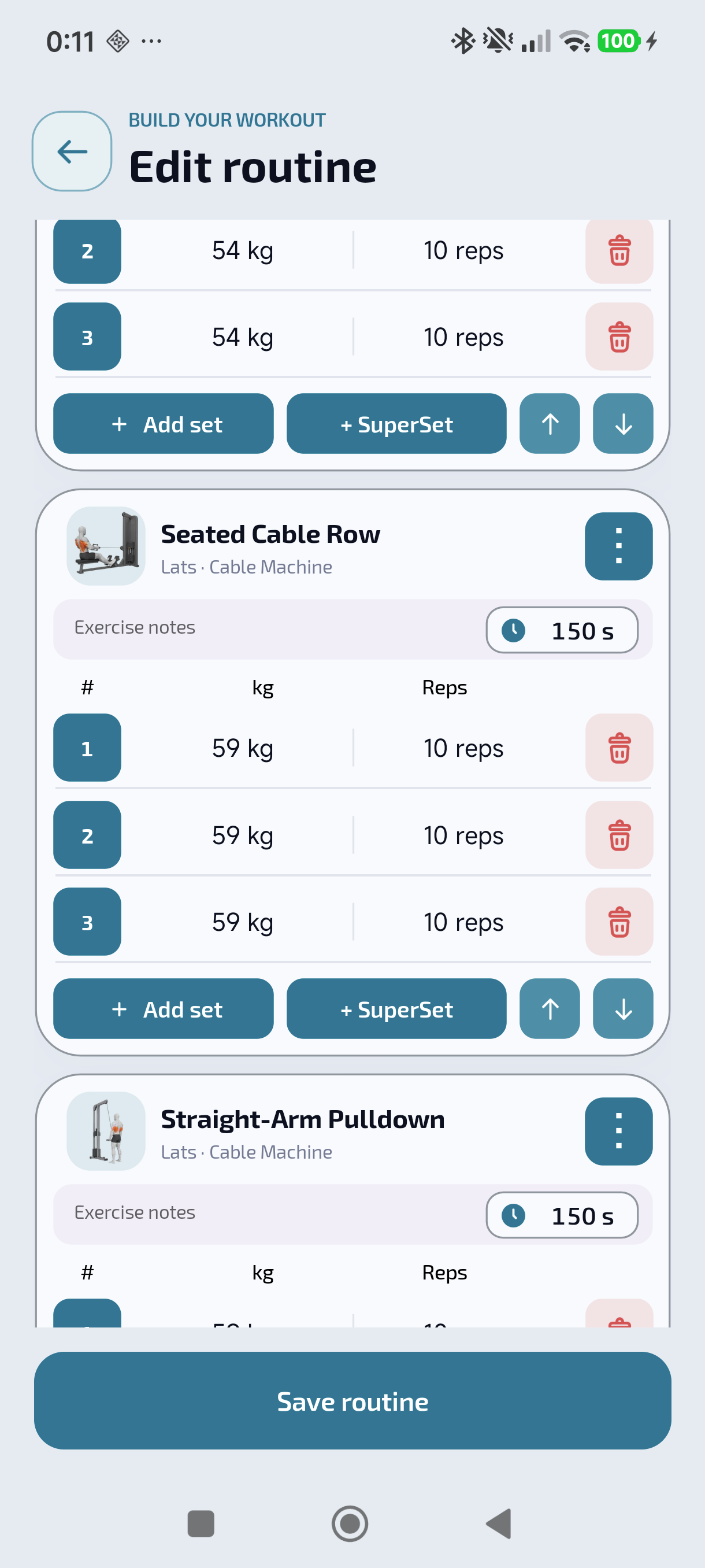
BarbellPin screenshot: configuring an exercise's sets.
Download BarbellPin