
Chess with the family: her dad had been practising
Irene sits down at the old chessboard, certain she knows her father's game. Then he makes a move she has never seen him make before.
BarbellPin ·
Irene finds the chessboard between the fruit bowl and the bread. Her father has set out the pieces and pulled up two chairs. She puts down a bag of mandarins and asks if he fancies a quick game. They have been talking about playing chess together for months, then watching videos or clearing lunch away instead. Today Ernesto points to her chair. “Quick depends on you,” he says. Irene laughs. She remembers who always took longer to move.
He taught her as a child. For a while they played every Sunday, and he warned her whenever she left a piece undefended. Later Irene began to win a few games, went away to university, and only found time for the board on longer visits. Now she is thirty-four and has a fairly fixed idea of her father's play. He brings his knight out early, comments on every threat and asks whether there is any coffee left before the end.
This time the coffee is ready. Ernesto has put two glasses of water safely away from the board and a notebook beside his chair. Irene assumes it contains the shopping list. She takes White, moves a pawn and begins describing a problem at work. Her father listens. When she finishes, he makes a different move from the one she expected.

Wooden chessboard with light and dark pieces. Photo: Annie Spratt, Unsplash. Unsplash License.
The knight went somewhere else
It takes Irene a moment to notice. She is still looking at the square where she expected to find it, like searching someone's usual desk without noticing them sitting nearby. She asks whether he has changed his mind. Ernesto says he is trying something different. He offers no further explanation. For the first time that afternoon, she looks at the whole board before moving.
Over the next few moves she talks less. Her father is keeping his usual commentary to himself as well. When Irene reaches towards a rook, he waits. She withdraws her hand without touching it and leans across the table. She has spotted a threat that could have cost her the piece. Ernesto drinks some water with an expression she cannot read. Perhaps he is pleased. Perhaps he is thirsty. She is irritated to find that she needs to know.
“Have you been playing online?” she asks. Yes, some afternoons. He also goes to a library on Wednesdays, where a few people meet with chessboards. He has been going for two months. Irene glances at the notebook. He opens it to a hand-drawn position with two arrows crossing. A woman at the group showed him an idea that only made sense when he tried it at home.
Irene feels a small sting. They speak several times a week, and she knew nothing about this. She is about to ask why he never told her. Then she remembers their recent calls: her listing meetings, him mentioning he had been out, her asking whether he needed shopping. There had been plenty of room for another question. She had never asked where he had been.
Advice nobody asked for
The position gets complicated. Ernesto puts a piece on a square Irene thinks is a mistake. The old warning escapes her, with their voices swapped: “If you do that, I can take your…” She stops. Her father keeps his hand still. “I've moved,” he says. He does not sound angry, but he does not sound grateful either. She nods and goes back to considering her own pieces.
For years she has enjoyed remembering the first time she beat him. She tells it as the moment they became equals across the board. Now she realises she has kept that equality inside an old photograph: she learned, he taught, and then they stayed roughly in those positions. She had left no room for her father to keep learning while she was somewhere else, occupied with things she thought of as new.
The capture she announced turns out less promising than she thought. There is a reply she missed. Irene loses her advantage and feels her face grow warm. She says work had distracted her. It was true at the beginning of the game; it is less true now. Ernesto points to her almost untouched coffee. “We can stop if you need to go.” She shakes her head rather too quickly. She still has time.
They play for several minutes without speaking. Outside, someone drags a bin along the street and a motorbike takes two attempts to start. Irene notices because she is no longer preparing her next anecdote. She studies the board, miscalculates a reply and eventually loses. Ernesto does not throw his arms up. He smiles, puts the piece down and asks whether she wants to see where the game changed.

Close view of wooden pieces on a chessboard. Photo: Jani Kaasinen, Unsplash. Unsplash License.
Reviewing a move leaves the result alone
Irene wants an immediate rematch. It seems the quickest way to remove the uncomfortable feeling. Instead she asks where she went wrong with the capture. Her father uses the notebook to rebuild the position, and together they work out which pieces were still on the board. They disagree about one square. Rather than invent a convenient move, they return to the last position they can both remember properly.
They try two replies. In one, Irene keeps her advantage; in the other, the problem returns. Ernesto admits he had not seen the entire continuation during the game. He had noticed a possibility and taken a chance. Irene prefers this explanation to imagining him following an unbeatable plan. They can discuss what each of them saw without turning the table into a classroom or taking his win away.
Then she asks about the library. Her father says one player brings a travel set and another always leaves at the same time to collect his granddaughter. Sometimes there is only time for one game. Irene asks how he found the group. He saw a poster while returning a book, went down one afternoon and stayed. The whole story takes a few sentences. The new part is that she listens to all of them.
They do not start another game. Ernesto has things to prepare, and she has arranged to meet someone later. They pack the pieces away, separating light from dark as they used to. Irene suggests coming back the following Sunday. “If you can,” he says. The library has an event that weekend too, and he does not know when it will finish. She takes out her phone and waits while he checks his plans.
In the entrance hall she finds a mandarin in her coat pocket. She picked it up when she arrived and cannot remember doing so. She messages her father to ask for a photograph of the position in his notebook. She wants another look tomorrow. He sends the picture with a warning: one piece is drawn on the wrong square. They will need to check it. Irene smiles at a question she cannot answer from memory.
Returning to a specific record is useful at the gym, too. In BarbellPin's history, you can find a saved session by date and open its details to check recorded weights and repetitions. The history guide explains the view; repeating a routine means starting a new session rather than reopening the finished one. Irene saves the chessboard photograph and gets her gym bag ready for tomorrow. This time she wants to look before assuming she remembers.
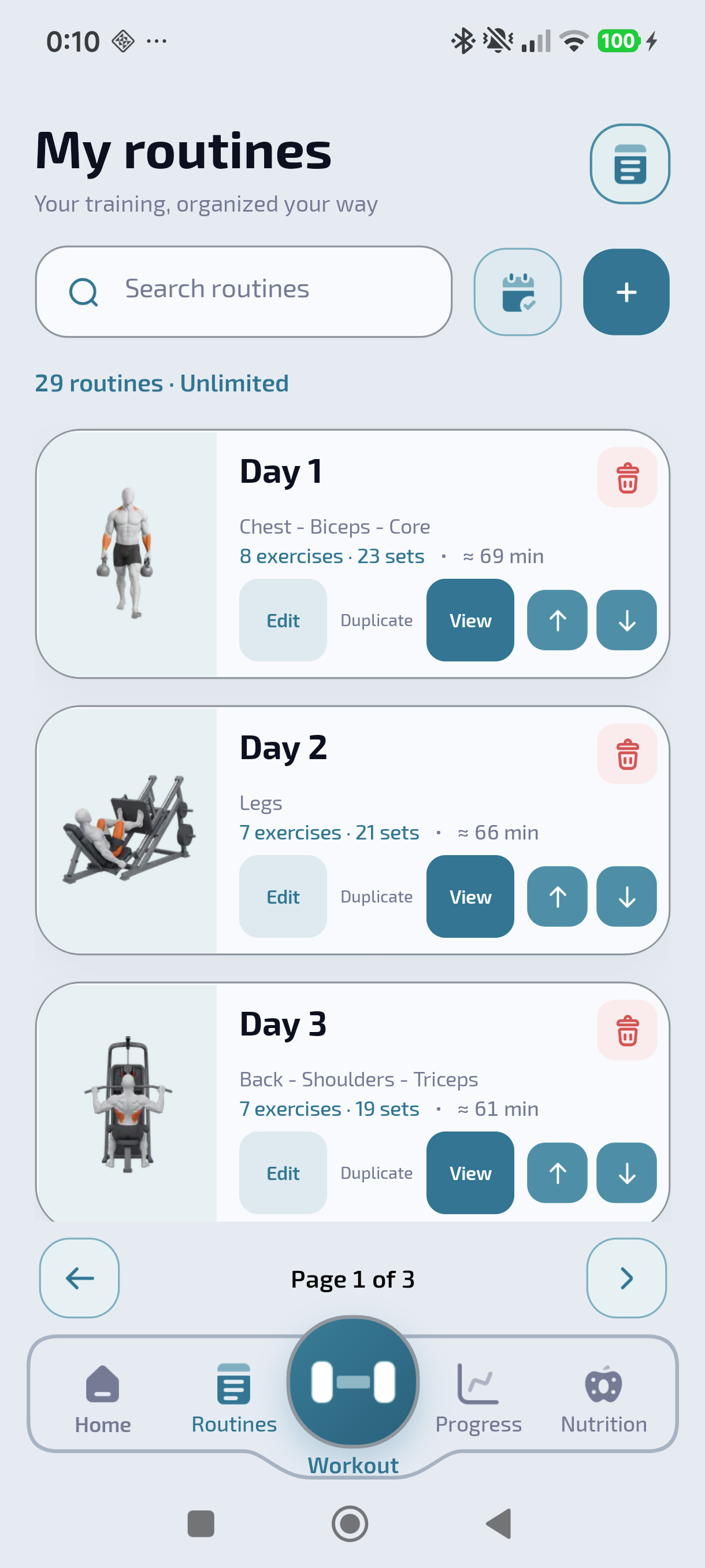
BarbellPin screenshot: routine list with names and exercise images. Source: BarbellPin, original screenshot authorised for its website.
Download BarbellPin